4 Aug 2026
NanoBanana vs SeedDream 4.0: Which AI Image Generator Wins in 2026?

Introduction
ByteDance’s SeedDream 4.0 took China by storm - but can it beat the playful power of NanoBanana?
In this NanoBanana vs SeedDream 4.0 comparison, we did more than look at a few pretty outputs. We tested both tools across creativity, realism, speed, workflow fit, and pricing to build a real AI image generator comparison 2025.
If you are wondering:
- Which AI image generator is better, NanoBanana or SeedDream?
- Which one deserves a place in your workflow?
- What is the best AI image generator 2025 for creators, marketers, or developers?
You are in the right place.
Before we get into the head-to-head test, it helps to understand what Nano Banana actually ishttps://www.nenobanana.com/blogs/what-is-nano-banana and why so many creators are treating it as more than just another text-to-image too
The Context: Two Opposite Philosophies
On one side, you have SeedDream 4.0 AI, a rising ByteDance AI image generator built around precision, consistency, and large-scale production. It feels engineered for systems, teams, and repeatable outputs.
On the other side, NanoBanana AI image generator feels faster, looser, and more creatively charged. It is built for experimentation, visual storytelling, and the kind of outputs that are not always technically perfect but often feel more alive.
This is not just another AI art generator comparison.
It is a comparison between two very different creative mindsets:
- SeedDream 4.0 favors control
- NanoBanana favors momentum
If you want a deeper look at SeedDream on its own, you can also explore our full SeedDream 4.0 review and guide https://www.nenobanana.com/blogs/seeddream-4.0, which breaks down usage, pricing, and technical positioning in more detail.
For readers who prefer to see the tool in action before diving deeper, this YouTube breakdown fits nicely here: SeedDream 4.0 walkthrough
Quick Comparison
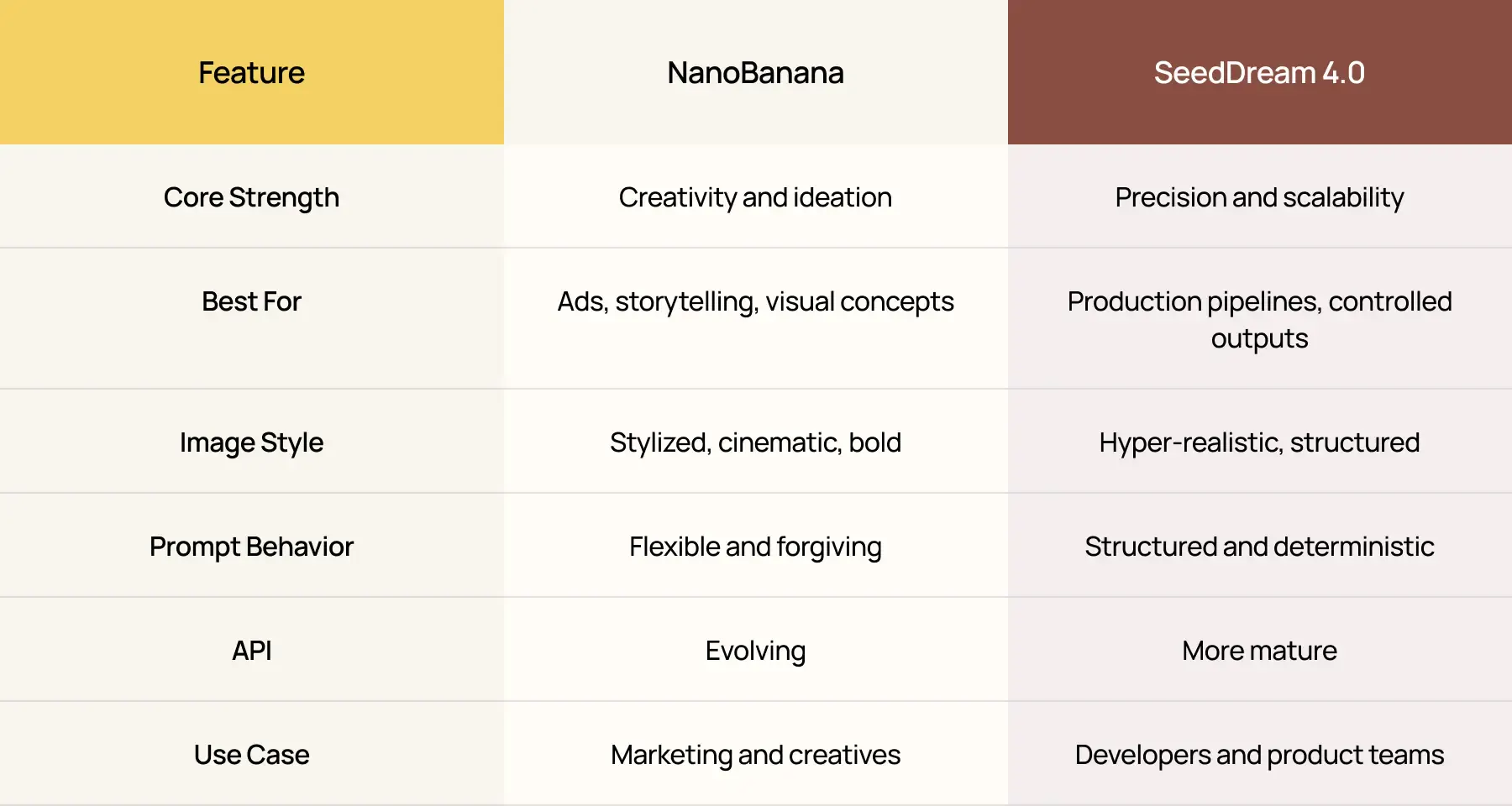
This table captures the big picture, but the interesting part starts when you look at how these tools behave under real pressure.
Image Quality: Realism vs Impact
When people compare text-to-image AI tools, they usually ask one question first:
Which one looks more realistic?
That matters, but it is not the full story. In a meaningful AI image quality comparison, the better question is:
Does the image do the job it was created to do?
SeedDream 4.0 - A Strong Realistic AI Image Generator
SeedDream stands out as one of the stronger options among the best text-to-image models 2025 if your priority is realism and control.
Strengths:
- Accurate anatomy
- Clean textures
- Strong lighting consistency
- Better repeatability across similar prompts
Best for:
- E-commerce product images
- Fashion photography
- Marketplace visuals
- Clean commercial renders
In practice, it behaves like a realistic AI image generator built for dependable output. If your team needs visuals that feel polished, consistent, and safe for production, SeedDream has a real edge.
This is also why it appeals to teams looking for an AI image generator for ecommerce product images or anyone prioritizing realism over artistic surprise.
For a practical outside perspective, this breakdown from AI Flow Review’s SeedDream 4.0 reviewhttps://aiflowreview.com/seedream-4-0-review/ is useful because it highlights where SeedDream feels production-ready versus where it still feels emerging.
NanoBanana - Built for Creative Impact
NanoBanana is different. It shines when the goal is not just realism, but reaction.
Strengths:
- Cinematic lighting
- Strong compositions
- Bold, scroll-stopping visuals
- Better creative interpretation from loose prompts
Best for:
- Social media creatives
- Campaign visuals
- Brand storytelling
- Product marketing ideas
- Fast ideation
This makes it a strong option for anyone looking for AI tools for content creation, AI tools for social media creatives, or an AI image generator for marketing that can move quickly from idea to output.
It also connects naturally with use cases where visual consistency matters across edits and iterations. If that is relevant to your workflow, how Nano Banana maintains character consistency across edits https://www.nenobanana.com/blogs/how-nano-banana-maintains-character-consistency-across-edits is worth reading, especially for teams building repeatable branded content.
If you want a more visual feel for how creators are comparing the results, this YouTube review is a helpful add-on: NanoBanana vs SeedDream discussion
Verdict: Quality Test
In this SeedDream 4.0 vs NanoBanana quality test:
- If you want realism and production cleanliness, SeedDream 4.0 wins
- If you want attention, emotion, and visual punch, NanoBanana wins
That is why this is not just a quality debate. It is a purpose debate.
Prompt Understanding & Creative Control
This is where the personality gap becomes obvious.
NanoBanana AI Review and Performance Test
NanoBanana performs best when your thinking is still fluid.
It handles:
- Abstract direction
- Mood-based prompts
- Aesthetic references
- Creative exploration
You can write something like:
“Luxury ring floating in liquid gold, soft beige lighting, editorial mood, premium feel”
And NanoBanana usually understands what you mean, even if the prompt is not rigidly technical.
That makes it one of the more intuitive creative AI image tools in the market right now. It reduces friction between idea and output, which is a big reason creators enjoy using it.
If you are still early in your workflow, our Nano Banana guide for beginnershttps://www.nenobanana.com/blogs/nano-banana-guide-for-beginners is a helpful companion piece because it shows how quickly non-technical users can start getting strong results.
SeedDream 4.0 AI
SeedDream works differently.
It rewards:
- Structured prompts
- Specific instructions
- Controlled input design
- Clear production intent
That makes it better for:
- Teams
- Documentation-heavy workflows
- Developers
- Repeatable pipelines
This is why SeedDream feels stronger for AI image generator comparison for developers and for teams evaluating text-to-image AI tools with API access.
A useful external comparison from Imagine Art’s NanoBanana vs SeedDream 4.0 article https://www.imagine.art/blogs/nano-banana-vs-seedream-4.0 also leans into this difference: NanoBanana feels more creatively forgiving, while SeedDream feels more system-friendly.
Another useful watch here is this creator breakdown on YouTube, especially if you want to compare prompt behavior more visually: SeedDream and NanoBanana prompt comparison
Insight
- NanoBanana lowers the barrier to creative exploration
- SeedDream 4.0 lowers the variability of output
That is a major difference, especially if you are deciding between a tool for brainstorming and a tool for production.
Speed & Workflow Efficiency
When comparing AI image generation tools, speed means more than render time.
It also means:
- How quickly you can test ideas
- How many iterations you can run
- How much prompt effort is required
- How stable the results remain across multiple attempts
NanoBanana
NanoBanana is generally better for:
- Rapid ideation
- Fast ad testing
- Creative iteration
- Concept development
If your job involves testing multiple visual directions in a short time, NanoBanana feels smoother and more energizing.
SeedDream 4.0
SeedDream feels better for:
- Stable production
- Controlled output generation
- More predictable repeat runs
- Large-scale workflows
That makes it stronger for high-volume AI image generation tools and AI tools for bulk image generation.
Practical Take
- Creative phase → NanoBanana
- Execution phase → SeedDream
This split is one of the clearest patterns we saw in the full AI image generation tools comparison.
API Pricing & Scalability
This is where the conversation becomes more technical - and more important for startups, product teams, and developers.
If you are doing a real AI image generator pricing comparison, you need to separate two questions:
- Which tool is better for humans using it directly?
- Which tool is better for systems running it at scale?
SeedDream 4.0 API Pricing and Features
SeedDream 4.0 is better positioned for:
- API integration
- Scalable generation workflows
- Platform-level implementation
- More predictable high-volume usage
That makes it attractive for:
- SaaS products
- Startups
- Internal creative tools
- Productized content systems
If your use case involves automation, scale, or large output batches, SeedDream has a stronger story around AI image API pricing and enterprise suitability.
This is one reason it performs well in searches like:
- SeedDream 4.0 API pricing and features
- which AI image tool is best for startups
- text-to-image AI tools with API access
For developers exploring integration paths on the NanoBanana side, getting started with the Nano Banana API in AI Studio and Vertex AI https://www.nenobanana.com/blogs/getting-started-with-the-nano-banana-api-in-ai-studio-and-vertex-ai is the most relevant internal reference point.
NanoBanana API Cost Per Image
NanoBanana currently feels more product-led than infrastructure-led.
Its strengths are:
- User experience
- Ease of experimentation
- Fast visual exploration
- Creator-friendly workflows
Its weaker side, at least for now, is that it feels less mature for deeply technical deployment compared with SeedDream’s more structured positioning.
So if your question is NanoBanana vs SeedDream pricing comparison, the honest answer is simple:
- NanoBanana feels stronger for creators and marketers using the tool directly
- SeedDream feels stronger for teams thinking in terms of scale, automation, and API economics
Verdict
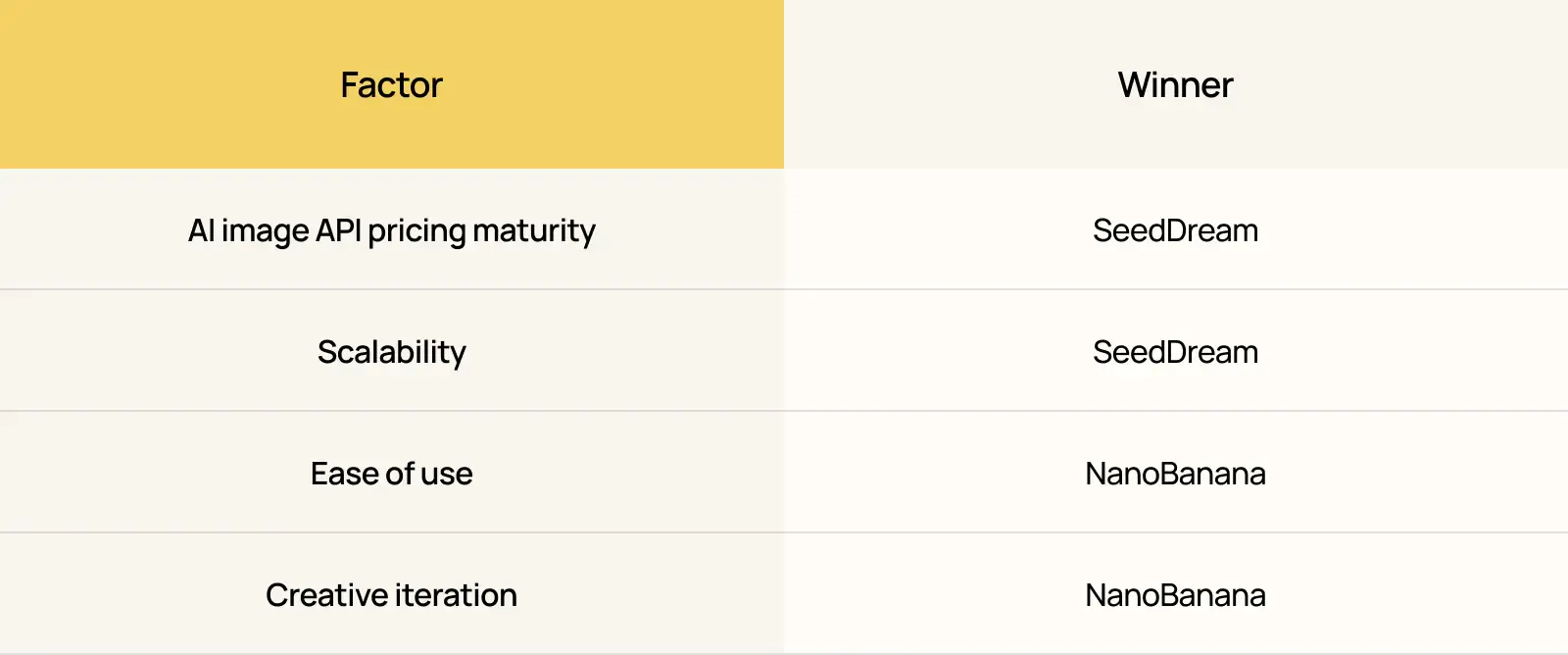
Use Case Breakdown
This is where the decision becomes practical.
Choose NanoBanana if you are a creator, designer, or marketer
NanoBanana is a better fit if you need:
- Social media visuals
- Campaign concepts
- Branded creative exploration
- Fast output with less prompt friction
That makes it a strong AI image generator for designers, a smart AI image generator for marketing, and one of the better AI tools for content creation if speed and creative direction matter more than rigid control.
It also performs especially well in visual commerce workflows. If your main use case is brand or catalog imagery, AI product photography made easy with Nano Bananahttps://www.nenobanana.com/blogs/product-photography-made-easy is a strong example of how the platform fits real-world product marketing.
Choose SeedDream 4.0 if you are a builder, developer, or product team
SeedDream is a better fit if you need:
- Predictable outputs
- API access
- Production consistency
- High-volume content generation
That makes it stronger for:
- AI image generator comparison for developers
- AI image generator for SaaS marketing
- high-volume AI image generation tools
- AI tools for bulk image generation
Best Hybrid Strategy
For many teams, the best answer is not choosing one over the other.
It is using both.
- NanoBanana for ideation
- SeedDream for production scaling
That is the smartest answer for teams asking:
- Which AI image generator is better NanoBanana or SeedDream?
- What is the best AI image generator for ads and creatives?
- Which AI image tool is best for startups?
Because in reality, the best workflow often uses different tools for different stages.
Real-World Testing Insight
Across product visuals, jewelry ads, landing page graphics, and branded creative concepts, a pattern emerged very quickly.
NanoBanana creates images people notice
Its biggest strength is attention.
The outputs often feel:
- More alive
- More stylish
- More cinematic
- Better suited for modern visual marketing
That makes it a natural fit for:
- AI image generator for product marketing visuals
- AI tools for social media creatives
- best AI tools for creative professionals 2025
SeedDream creates images people trust
Its biggest strength is confidence.
The outputs often feel:
- Cleaner
- More controlled
- More commercially usable
- Better for repeated production workflows
That makes it stronger for:
- AI image generator with best realism and control
- best AI image generator for realistic images 2025
- AI image generator for ecommerce product images
This community discussion on Reddit - “I believe SeedDream is on par with NanoBanana now” https://www.reddit.com/r/nanobanana/comments/1ngidkz/i_believe_seedream_is_on_par_with_nanobanana_now/ - is also worth reading because it reflects how quickly perception is changing among active users. The interesting part is not whether everyone agrees. It is that the comparison is now close enough to be seriously debated.
Final Verdict: Best AI Image Generator 2025
If you want a one-line answer to this NanoBanana vs SeedDream 4.0 debate, here it is:
There is no universal winner.
There is only the right tool for the right job.
NanoBanana wins for creators
Best for:
- Ads
- Branding
- Social content
- Creative professionals
- Fast-moving concept work
SeedDream 4.0 wins for builders
Best for:
- APIs
- Scalable platforms
- Automation
- Controlled production pipelines
- Realistic output systems
So if you are asking:
Which AI image generator is better, NanoBanana or SeedDream?
The honest answer is:
- Choose NanoBanana for creativity and speed
- Choose SeedDream 4.0 for realism, control, and scale
The Real Takeaway
This AI image generator comparison 2025 proves something important:
The market is no longer about one perfect winner.
Instead, the winners are the teams that know how to pair the right tool with the right objective.
- Need attention → NanoBanana
- Need accuracy → SeedDream 4.0
- Need both → build a workflow that uses both
That is the real answer behind SeedDream 4.0 vs NanoBanana.
That is why this is not just a battle for the best AI image generator 2025.
It is a lesson in how modern creative workflows are evolving.
Closing Thought
The future of generative AI image tools is not one model dominating everything.
It is specialization.
NanoBanana feels like the stronger choice for people who want expressive visuals, quick experimentation, and strong creative momentum.
SeedDream feels like the stronger choice for people who need scalable systems, cleaner realism, and more structured output control.
And if you combine them intelligently, you get the best of both worlds:
- NanoBanana for ideation
- SeedDream for production


