28 May 2026
SynthID Watermarks Explained: How to Detect, What They Mean (2026)

Introduction
Every image you generate with Nano Banana, every audio clip from Lyria, and every long-form text from Gemini ships with a watermark you can't see, can't hear, and can't read — but software can.
That watermark is Google DeepMind's SynthID, and as of 2026 it has been applied to more than 10 billion pieces of content, making it the most widely deployed AI watermarking system in the world.
If you're a creator working with AI tools, a publisher fighting deepfakes, a journalist verifying sources, or just someone trying to understand what's actually marked on these images you keep generating — this is the guide.
Plain-English, with the technical details where they matter, and the honest limitations researchers have surfaced over the past year.
What SynthID Actually Is
SynthID is a system built by Google DeepMind that embeds an invisible signal into AI-generated content. The signal is statistical — it nudges pixels, sound frequencies, or token probabilities by tiny amounts that a human can't detect, but a paired detector neural network can identify with high confidence.
Originally launched as a research project in 2023, SynthID is now the default invisible watermark on every output from a Google generative model, perDeepMind's official documentation.
It Works Across Four Content Types
- Images — visible and invisible variants, with the invisible one being the default for outputs from Gemini Image, Nano Banana, Imagen, and other Google image models.
- Audio — embedded into music from Lyria and audio generated by Google's audio models.
- Text — modulates token probabilities during generation in Gemini-family LLMs.
- Video — extends the image approach across frames.
How SynthID Works for Images
The image variant is what most readers care about. It uses two coordinated neural networks.
Network 1: The Embedder
During image generation, or post-generation, this network looks at the image and makes tiny adjustments to pixel values across the image.
The adjustments are imperceptible to the human eye — you cannot tell the difference between a watermarked image and the same image without the watermark.
The pattern of adjustments is mathematically structured so the detector can later identify it.
Network 2: The Detector
Given any image, this network analyzes the pixel patterns and returns a confidence score on whether the image carries the SynthID watermark.
The detector is robust to standard image transformations — SynthID survives cropping, compression, filtering, rotation, and even screenshots, per Google's own characterization and additional guides like this DataCamp SynthID tutorial.
The Technical Insight
Instead of stamping a logo in the corner, SynthID modifies the statistical distribution of pixel intensities in a way that survives transformation.
Think of it like an audio watermark that survives MP3 compression — it's encoded into the structure, not the surface.
For audio, the technique is similar — frequency-domain modulation that survives MP3 compression, noise addition, and speed changes.
For text, it modulates the probability of certain tokens being generated, which downstream paraphrasing partially preserves.
What SynthID Is Watermarked On as of 2026
A non-exhaustive list of content types currently watermarked with SynthID:
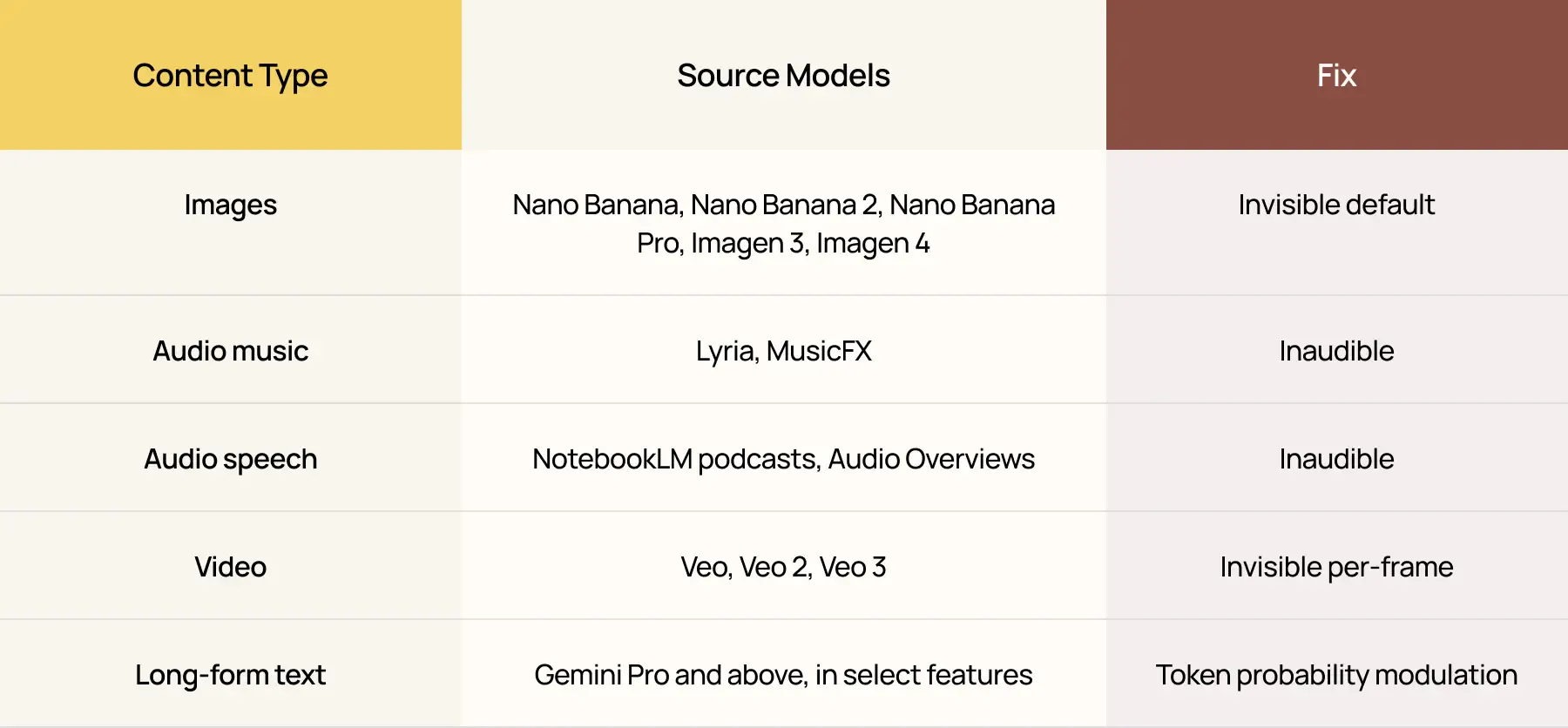
If you're working with Nano Banana for interior design, character consistency, virtual try-on, or product photography, every output is SynthID-watermarked.
How to Detect a SynthID Watermark
There are three practical paths, ranked by accessibility.
1. Ask Gemini
The simplest detection method: drop an image into the Gemini app or website chat, and ask:
Was this image generated or edited by Google AI?
Gemini will run SynthID detection on the image and report back, per Google's SynthID Detector announcement.
Confidence levels are reported.
2. Use Google's SynthID Detector
Google launched a dedicated SynthID Detector portal for journalists, researchers, and content moderators.
It accepts:
- Images
- Audio
- Video
- Text
It returns a detection result with confidence and works on content from Google's models.
What It Does Not Detect
It does not detect watermarks from other model families such as:
- Stable Diffusion invisible watermarks
- Midjourney watermarks
- OpenAI watermarking systems
- Other non-Google watermark systems
Those use different systems.
3. Use SynthID Detect on Vertex AI
For enterprise customers, SynthID detection is available via the Vertex AI API and Gemini-related workflows, including Google's Gemini API documentation.
This is useful for automated detection in:
- Moderation queues
- Fact-checking workflows
- Publisher verification systems
- Platform safety pipelines
What Is Not Available
A public open-source detector is not available.
The detector neural network is closed. You can only access detection through Google's services.
This is a deliberate trade-off — making the detector available openly would make it easier to train models to evade it.
What SynthID Means If You're Generating AI Content
There are three practical implications.
1. Your AI Images Carry an Invisible Watermark
Your AI images carry an invisible watermark, and it's permanent across normal edits.
You can crop the image, compress it, post it to Instagram, screenshot it, or run it through Photoshop's basic adjustments — the watermark generally survives.
This is a feature for transparency. It's a constraint if you want plausibly-deniable AI output.
2. AI Detection Tools Can Flag Your Images as Google-Generated
Not all AI detection works.
But SynthID specifically does, and detection tools that check for SynthID — Hive, Reality Defender, Optic, and others integrating Google's detection — will return a positive signal on your Nano Banana outputs.
If you are using Nano Banana through OpenRouter, the image is still generated by Google's backend and arrives with the watermark intact.
3. SynthID Does Not Show Up in EXIF or Metadata
SynthID is purely pixel-level.
Stripping EXIF, which many social platforms do automatically, does nothing to remove SynthID.
This is different from C2PA, which lives in metadata.
For most commercial use — interior design mockups, product photography, marketing images — none of this matters.
The watermark doesn't affect appearance, doesn't restrict use, and doesn't show up in the print.
It just means if someone asks “is this AI?”, the answer is verifiable.
SynthID vs C2PA: They're Different Things
A common confusion: SynthID and C2PA are often mentioned together, but they're different mechanisms.
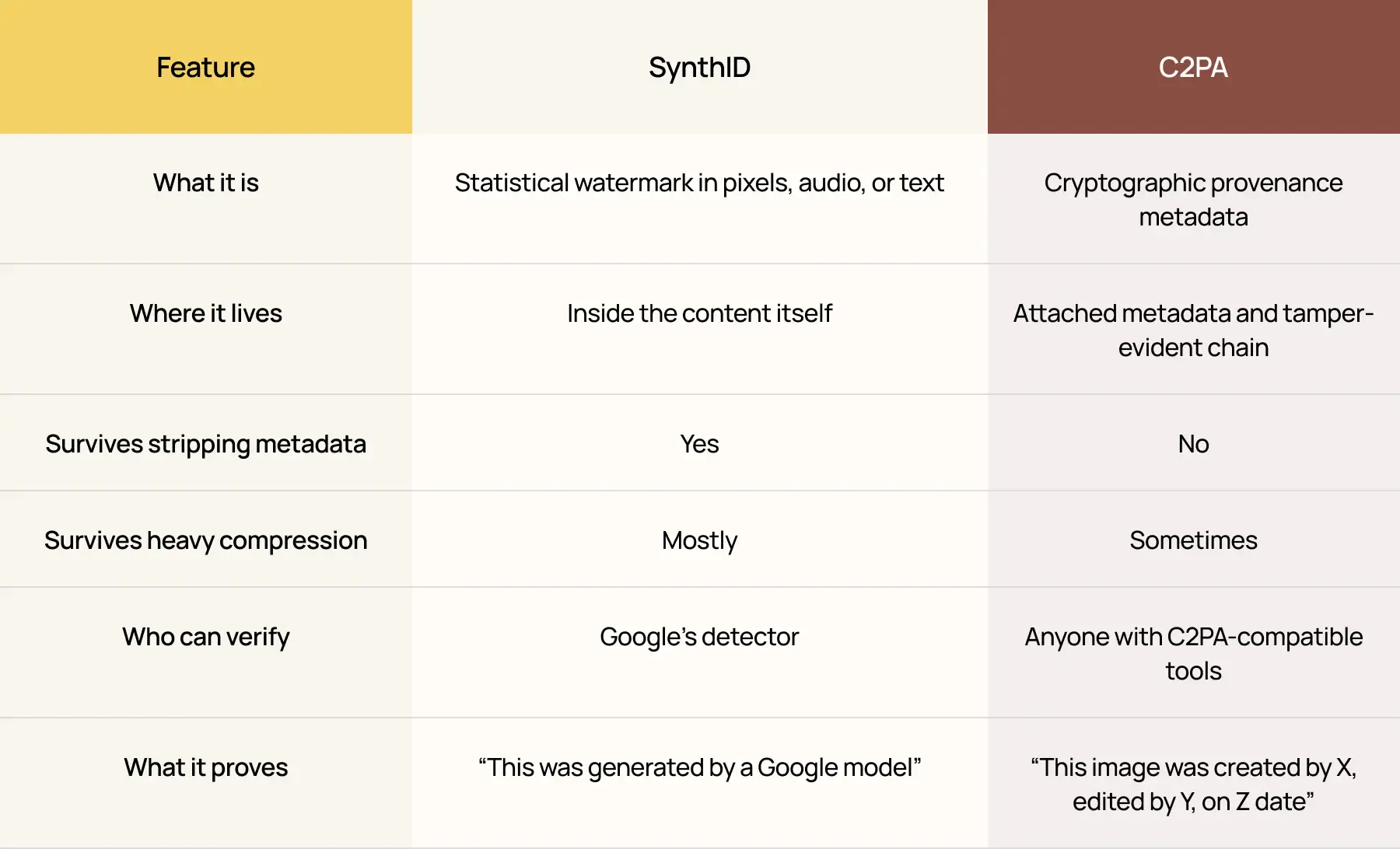
The intent is for these to work together.
SynthID provides a robust, in-content signal that survives even when metadata is stripped.
C2PA provides rich, human-readable provenance that anyone can inspect.
Together, they make AI content traceable from generation through publication.
Nano Banana 2 outputs ship with both. The SynthID watermark is always present; C2PA metadata is attached by default and can be inspected by tools that read C2PA.
The Honest Limitation — SynthID Has Been Broken
In 2024, security researchers at the University of California demonstrated that SynthID can be broken using spectral analysis.
The attack analyzes pixel patterns across many watermarked images, reverse-engineers the embedding structure, and either removes the watermark or transfers it to non-AI images, causing false positives.
You can read more about this in thisReverse-SynthID attack writeup.
What This Means Practically
- The watermark is not unbreakable. A motivated adversary with technical skills can remove or spoof it.
- Google has acknowledged the limitation. SynthID was always positioned as one layer in a defense-in-depth approach to AI transparency, not a silver bullet.
- For 99% of users, it doesn't matter. Casual users, content moderators, and journalists are still well-served — the attack requires significant technical work and isn't trivial.
- For high-stakes provenance such as legal or journalism use cases, SynthID alone is insufficient. Combine with C2PA and human verification.
This is the realistic 2026 read:
SynthID is a useful signal, not a guarantee.
Can I Remove the SynthID Watermark From My Own Images?
There are three honest answers, depending on what you want.
1. If You Want Plausible Deniability for General Use
Heavy edits, AI-to-AI roundtripping, such as generating with Nano Banana then re-running through Stable Diffusion image-to-image, and significant resizing can weaken the watermark to below detection threshold.
This is not officially supported and may violate the terms of service for the original model.
2. If You Want to Remove It for Legitimate Reasons
For legitimate reasons such as artwork submission to a non-AI competition or journalistic source protection, ask the publisher first.
Many submission guidelines explicitly cover AI use.
Workarounds are rarely worth the risk.
3. If You Want to Evade Detection Systems at Scale
The spectral-analysis attack works.
But it's an adversarial action that violates Google's terms of service and likely the policies of platforms that rely on SynthID detection.
Don't.
Honest Summary
The watermark is a feature, not a bug, and most legitimate use cases don't require removing it.
What This Means for Specific Use Cases
For Interior Designers and Architects Using Nano Banana
SynthID doesn't affect your client mockups.
The watermark is invisible to the client.
Disclose AI use in your contract if relevant; the watermark is corroborating evidence, not the disclosure itself.
For related workflows, you can also read theNano Banana interior design mockups guide.
For E-commerce and Virtual Try-On
Customer-facing images carry the watermark.
If your retail platform requires non-AI imagery, source those photos elsewhere.
Most platforms in 2026 allow AI imagery with disclosure.
For more context, see thevirtual try-on with Nano Banana guide.
For Journalists Publishing AI-Generated Explainer Images
SynthID provides automatic provenance.
Your readers and editors can verify the AI origin via Google's detector.
This is generally a good thing.
For Marketing Teams
SynthID doesn't restrict commercial use, doesn't affect image quality, and isn't visible.
It does mean third-party AI detection tools can flag your imagery — relevant if your brand has a “no AI” public position.
For marketing-related visuals, theproduct photography with Nano Banana guide may also be useful.
For Developers Building Products on Nano Banana
Via OpenRouter, Bylo.ai, or direct Google API — all outputs are watermarked.
Your end users won't see it; your end-user-facing AI detectors will.
For Competitive AI Tools
Tools like Qwen Image Edit, SeedDream 4.0, and Hunyuan Image 3.0 don't carry SynthID.
They typically have their own watermarking systems, or none at all.
How SynthID Compares to Other AI Watermarking Systems
Here is a quick map of the watermarking landscape in 2026:
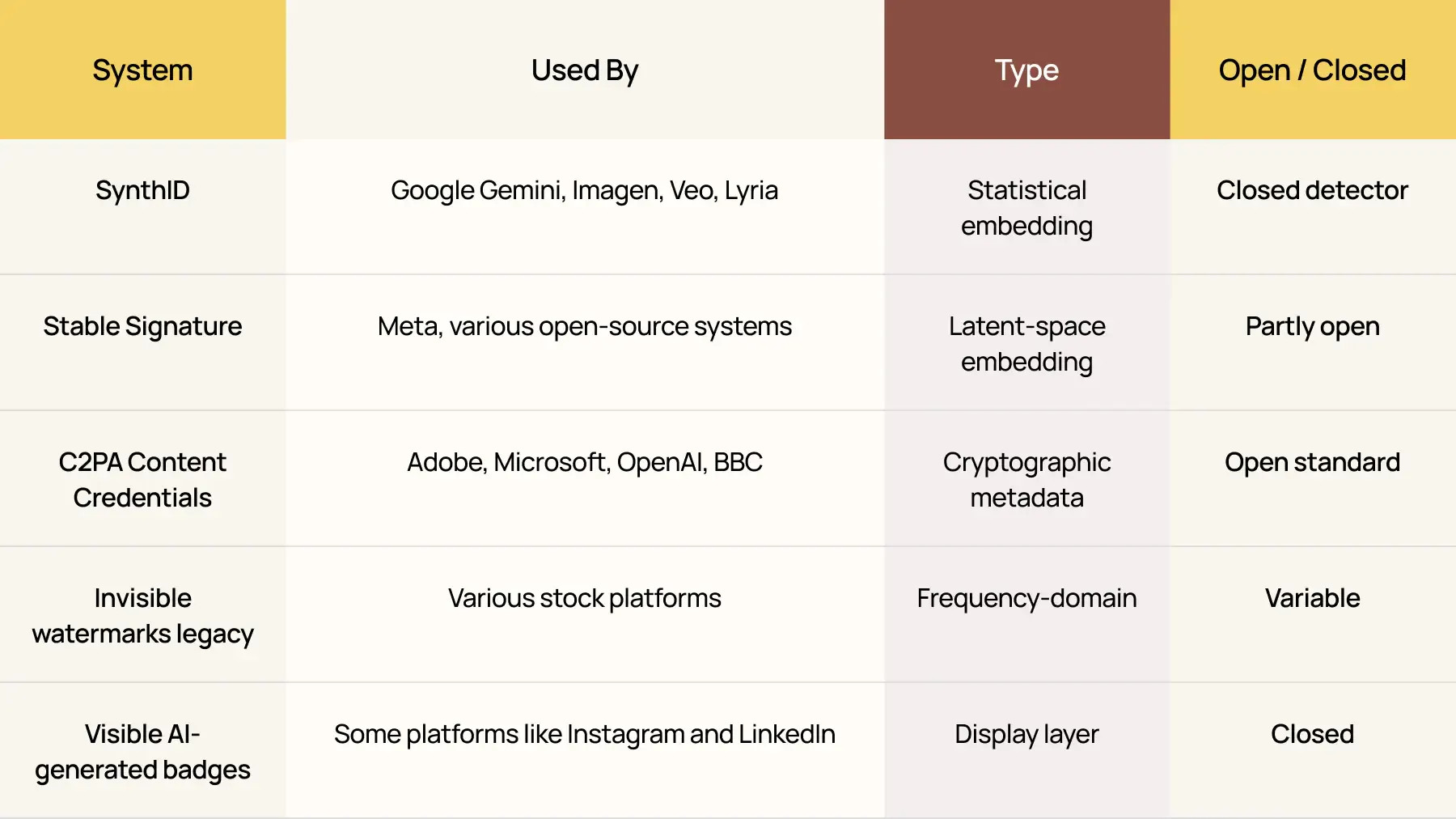
SynthID is unusual in being widely deployed, highly robust, and entirely invisible.
Its weakness is closed verification — you trust Google's detector to be honest.
C2PA is the open counterweight.
For maximum transparency, expect tools and content to ship both SynthID and C2PA in the near future.
Nano Banana 2 already does.
Frequently Asked Questions
Are Images From Nano Banana Watermarked?
Yes. Every image from Nano Banana, Nano Banana 2, and Nano Banana Pro carries an invisible SynthID watermark.
Can I See the SynthID Watermark in My Image?
No. It's invisible to the human eye, by design.
You can detect it via Google'sSynthID Detector or by asking Gemini.
Does SynthID Affect Image Quality?
No measurable difference.
The pixel-level adjustments are below visual perception threshold.
Does SynthID Survive Screenshots, Cropping, and Compression?
Mostly yes.
PerGoogle DeepMind's documentation, the watermark survives typical transformations including cropping, JPEG compression, filtering, rotation, and screenshots.
Can SynthID Be Removed?
Casual editing won't remove it.
A 2024 research paper demonstrated a spectral-analysis attack that can remove or spoof the watermark, but it requires technical skill and is not trivial.
Does SynthID Work on Text From Gemini?
Yes, for sufficiently long passages.
Token-level probability modulation requires enough tokens to extract a statistical signal — short paragraphs may not be reliably detectable.
Is SynthID Legally Required for AI Content?
Not currently in most jurisdictions, but the EU AI Act and similar emerging regulations are pushing toward mandatory disclosure.
SynthID is one mechanism for compliance.
Can Third-Party AI Detection Tools Detect SynthID?
Some integrate Google's detector via API.
The detector itself isn't open-source.
Tools that integrate it can reliably flag SynthID-watermarked content; tools that don't usually can't.
Does Using OpenRouter Strip the SynthID Watermark?
No.
OpenRouter is just an API proxy — the image is generated by Google's backend and arrives with the watermark intact.
Is SynthID Different From C2PA Content Credentials?
Yes.
SynthID is a statistical watermark in the content itself.
C2PA is cryptographic provenance metadata attached to the file.
They're complementary — Nano Banana 2 ships with both.
The Practical Takeaway
If you're using Nano Banana for commercial work, day-to-day, the SynthID watermark is mostly a non-issue.
It doesn't change how the images look.
It doesn't restrict your commercial license.
It doesn't show up in print, on social, or in your client's brand book.
What It Does Mean
- AI detection tools that integrate Google's verifier will flag your imagery.
- Transparency around AI use is verifiable, not just claimed.
- For high-stakes provenance, such as journalism or legal use cases, pair with C2PA and human verification.
- For everything else, treat it like an invisible “made with Google AI” stamp that doesn't affect anyone's experience.
For the broader Nano Banana ecosystem, see the What Is Nano Banana primer and the Nano Banana beginner's guide.
For setting up API workflows with watermark detection built in, see theOpenRouter guide.


